LUCI BIZANTINE (2026)
for violin, cello, and harp [10:30]
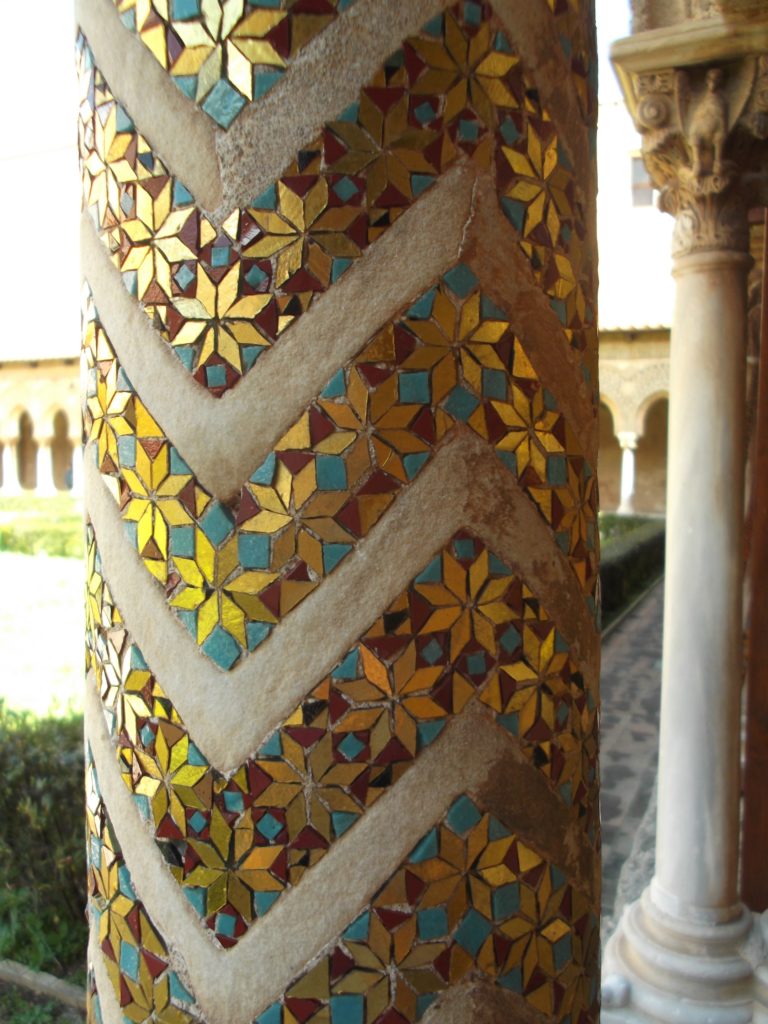
The title Luci Bizantine (“Byzantine Lights”) comes from a poster produced in Venice by St. Mark’s cathedral, depicting its geometric floor mosaics. A visit to the cloisters at Monreale during my first trip to Palermo was also a decisive influence: each column has its own unrelated geometric motif.
The form of the piece takes its inspiration from this kind of presentation: 20-30 seconds in a given pattern, then a sudden change of mode, tempo, and texture. Certain shapes can be heard to repeat, others are replaced. The technique of the West African kora — two interlocked hands, loud and expressive — significantly influenced the harp part, whereas the Balinese concept of ramé, an aesthetic orientation towards busy-ness, also plays a role.
In other moments, I was thinking about the expressive monodic Byzantine chant and its overlapping history with Arabic maqam, a system where mosaic modes are constructed from limited building blocks; the microtonal glissandi in the the strings bring this to mind. A ‘buzz’ effect — common in West Africa and hindustani music — is achieved by preparing one string each on the cello and violin with aluminum foil.
More broadly, I am aiming for a busy, repetitive rhythmic language that draws the ear’s focus in the same way West African drumming patterns or Cuban clave occupy the listener’s attention. Layers of intricate polyrhythm are intertwined so that accents rub up against one another. Meanwhile, the harp is tuned with quarter-tones in every octave, shooting for a transposable consonance that adds a kinetic sense of geometric gyration to the shifting tableaux…